

Air Conditioner Buying Guide
How to choose an air conditioner based on the square footage and the needs of your space.
Are you looking for a new air conditioner and feeling confused by the many options available on the market, or maybe you don’t know where to start and what to look out for? Don’t worry! Below we’ll go through together the factors you should take into account so you can end up with the ideal choice for your space.
➡ And before we see what you should pay attention to, don’t forget that with a purchase through Skroutz you get:
- Free delivery to your floor (yes, even to the 5th floor).
- Free returns in case you change your mind.
- 2-year warranty for every eventuality (repair, replacement, or refund) so you can have peace of mind.
- After-sales support for whatever you need after your purchase.
In short, you shop without stress.
Before we proceed, however, if you want to learn only the essentials and nothing more, you can find options based on the space where you want to place your new air conditioner:
Choose an air conditioner based on your space:
Let's now look at the factors you need to consider to choose the ideal air conditioner.
1. Power (BTU)
The power of an air conditioner is calculated in BTU/h (British Thermal Unit) and is always listed in its technical specifications. The general rule is that the more powerful an air conditioner is, the larger the space it can cover. In every air conditioner, you will find 3 power values. The nominal power, the cooling power, and the heating power.
But what does each power value express?
- Nominal power (performance): It reflects the maximum performance of the air conditioner under ideal conditions, without taking into account external factors such as the actual temperature or the humidity of the environment.
- Cooling power: On the other hand, the nominal cooling performance reflects the ability of the air conditioner to remove heat from a space.
- Heating power: Meanwhile, the value of the heating power reflects the thermal energy that the air conditioner can produce to heat a space.
SkroutzTip: Consider the nominal performance to make the right choice based on your space (square meters), while depending on whether you plan to use the air conditioner more in the summer, focus on the cooling power and correspondingly for the winter on the heating power.
To determine how many BTU the air conditioner you choose needs to have based on your space, calculate approximately 750 BTU per square meter in each room. You can consult the table below to avoid purchasing an excessively small or large air conditioner (in terms of BTU).
Indicative BTU per Room Square Footage Correlation Table:
2. Noise Levels (dB)
The noise generated during the operation of the air conditioner is one of the most important selection criteria, especially in cases where the air conditioner is intended for installation in the bedroom. The noise level is measured in dB (Decibel), for both the indoor and outdoor unit, and for an air conditioner to be classified as low-noise, it should:
- have the indoor unit value range from 50dB to 55dB
- and the outdoor unit accordingly from 50dB to 70dB.
Finally, if you are interested in using the air conditioner while sleeping, it is useful to look for a model with a relevant function, such as the following: “Sleep”, “Ultra Silence” or “Quiet mode”.
3. Energy efficiency
Energy class
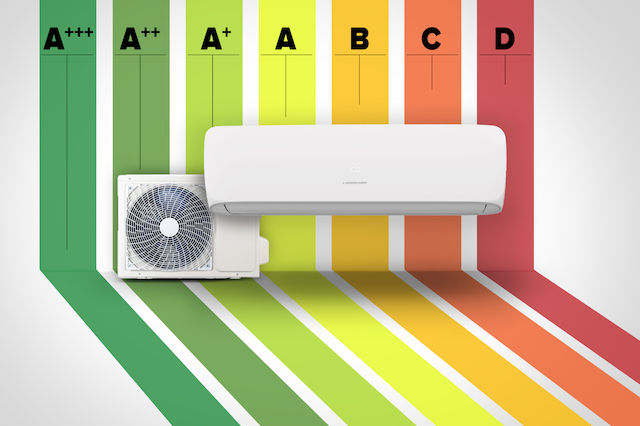
Most household appliances you can find on the market (e.g. refrigerators, washing machines, cookers, etc.) are categorized into energy classes, and the same applies to air conditioners. The categorization is based on their energy efficiency, that is, the useful amount of energy they release into the space, in relation to what they consume for both cooling and heating operation. The energy class is measured on a seven-level color scale, from A+++ to D, with class A+++ being the most efficient, while class D is the least efficient. So if you are looking for a premium air conditioner with a top energy class you should look for air conditioners with an A+++ rating for both cooling and heating.
SCOP & SEER indicators
However, energy efficiency is also reflected, in addition to the class, by two more indicators. The seasonal coefficient of performance for heating (SCOP) and the seasonal energy efficiency ratio for cooling (SEER) respectively. The higher the indicator, the more efficient the unit is in the specific operation. So, if you are interested in using the appliance more in summer, then take into account the indicator SEER, while if you intend to use your air conditioner mainly in winter, focus on the indicator SCOP.
SkroutzTip: The fact that an air conditioner has an energy class "A+" in cooling mode does not mean that it has the same energy class in heating mode. Therefore, it is important to study the energy label of the unit you are interested in as well, where the cooling - heating performance is listed in detail.
The table below presents the classification of air conditioners into energy classes, based on the seasonal energy efficiency ratings for cooling and heating:
Energy Label
According to EU legislation, for better consumer information, manufacturers are required to issue the updated energy label for each unit, providing information about the energy characteristics of the air conditioner, such as the energy class, the above indicators, or noise levels.
⬇ Learn how to read the energy label easily and quickly:

4. Extra functions
Beyond the energy and technical features, however, in an air conditioner the extra capabilities and functions it offers also play a role. Depending, therefore, on your needs and preferences, you can look for some of the following when choosing:
Ionizer
The technology for cleaning conditioned air is constantly improving, and most modern air conditioners are equipped with advanced air purification filters, such as activated carbon filters and HEPA, so that dust, particles, and microorganisms are retained.
The evolution of filters led many manufacturers to equip their models with an ionizer, that is, a filter of advanced electronic technology (cold plasma filter). The ionizer in air conditioners uses electric fields, releasing positive and negative ions into the air, which neutralize bacteria and viruses, while also trapping dust, odors, and suspended particles, providing a high-quality atmosphere in our space.
The ionizer function is recommended if the air conditioning unit is intended to be used in smoking areas and in cases of people who suffer from allergies.
Dehumidification function (Dry)
Don't have a dehumidifier? No problem!
Units that have this dehumidification function with the indication “dry” can remove moisture from the indoor air and make it fresher, provided that the set temperature on the air conditioning unit is lower than the room's indoor temperature.
WiFi
How nice is it to come home and have already turned on the air conditioner 10 minutes earlier, so you can walk into your cool room? How does this happen? Through the corresponding app that air conditioners supporting WiFi connection have.
If you're interested in WiFi, pay attention to the distinction between WiFi Direct and WiFi Ready: In the first case, the unit has a built-in WiFi transmitter and receiver, while in the second, you need to purchase an adapter (dongle).
What other factors should you consider when choosing?
5. Installation & uninstallation
A basic requirement for the effective operation of our air conditioner is its placement and installation by experienced technicians, in order to avoid any failures that may lead to problems such as poor performance, excessive energy consumption, and loss of warranty.
So, during your market research, you should check whether installation is included in the purchase price.
For the proper placement of the air conditioner, you should take into account the following factors:
- Indoor unit placement point: Ideally at a sufficient height so that the air in the room is distributed evenly (e.g. 1.8 or 2 meters from the floor), the direction of the air does not blow directly on you, and the unit is as much as possible on the side of the windows in a shaded area, and not above another source/device that emits heat, so as to reduce temperature loss.
- Outdoor unit placement point: In a place with easy access for maintenance, at a short distance from the indoor unit (from 1.5 up to 8 meters maximum), and with the minimum required clearances around the unit, so that it is properly ventilated and the direction of the discharged air is not toward nearby windows, balcony doors, etc.
- The outdoor unit should be secured on a sturdy surface on anti-vibration rubber mounts, to prevent resonance and vibrations.
- Piping: The technician performing the installation should ensure the proper routing, protection, and insulation of the piping.
- Drainage: The drainage pipes should be made of the proper material, and should end in a drain, a balcony or floor siphon, or garden soil.
Here you will also find the device installation services supported by Skroutz for each category!

6. Maintenance & Cleaning
We recommend maintaining your air conditioner by specialized refrigeration professionals, usually once a year, who will address existing damages or prevent their occurrence. The maintenance of the air conditioner should also be carried out on both the indoor and outdoor units.
Some common signs indicating the need for unscheduled maintenance include a drop in the air conditioner's performance compared to the past, if you notice an unpleasant odor in the air upon activation, and finally, if there are signs of water leakage in the indoor unit. In addition to regular maintenance by specialized personnel, frequent cleaning of the filters and blades of the indoor unit from dust is also recommended, as it gradually affects the air conditioner's efficiency.
If cleaning and maintenance are applied regularly and thoroughly, we achieve improved performance of our air conditioner and extend the device's lifespan, while simultaneously ensuring noticeable reductions in electricity consumption.
Don't forget! By taking into account the above individual characteristics and combining those that suit your needs, you can arrive at the ideal choice for you. Before deciding, you can also take a look at the reviews of other users, to see their opinions and experiences, which can help you reach a final decision much more easily.
- You can also take a look at the guide with the best air conditioner options for every space and need, to help you more easily decide on the ideal choice for you.
- Are you looking for professional solutions? Discover Professional Inverter Air Conditioners for every use!
Are you looking for professional solutions? Discover Professional Inverter Air Conditioners for every use!


Be the first to leave a comment!