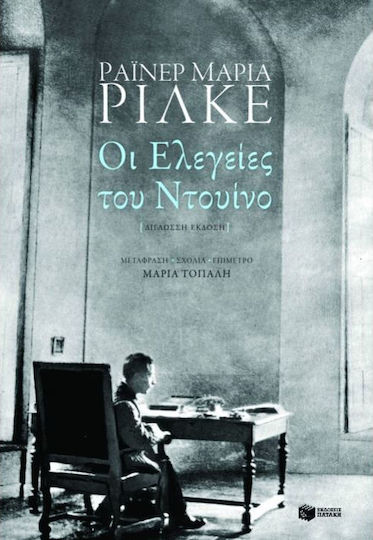
The Duino Elegies, along with the Sonnet to Orpheus, comprise Rilke's foremost work, which he consciously and painfully nurtured within himself for a full ten years (1912-1922). In addition to the "lovers" and the "loving woman" abandoned by her beloved, the "Elegies" weave around two more central figures: the "angel" and the "young dead man." Rilke uses them to demonstrate the inability to fully experience human emotion as well as the need for humans to be liberated from the shackles of reality.
His "request" is linked to the negative image he has of the modern, industrial world that collapsed into the barbarism of war. With the "Duino Elegies," German-language poetry reaches a peak while simultaneously being renewed. Musil's view is characteristic in stating that Rilke "perfected the German poem for the first time."
Zweig speaks of "infinite stretching of the language, which needed to transcend its limits and bend into the unfathomable abysses," placing Rilke—thanks to the "Elegies"—on the same level of poetic greatness as Hölderlin and Novalis. Topali's interpretive approach arises from the continuous verification through the rich annotated edition of the sources (Materialien) and the annotated edition of the "Elegies," of the insights generated by "intensive reading."
What is verified and ultimately supports both in the profound notes and primarily in the rich afterword, is the uniqueness of a poet who transcends every Procrustean literary bed, both of his predecessors in the Romantic school such as Hölderlin or Novalis, and that of Modernism, with its representatives like Eliot or Pound, with whom he also shares kinship ties.


 7 Coins
To earn Skroutz Coins, join Skroutz Plus and accept the terms of the reward program.
7 Coins
To earn Skroutz Coins, join Skroutz Plus and accept the terms of the reward program.