

Fire Safety Guide: The New Legislation, Deadlines & the Right Equipment
The security of your home is non-negotiable, but in recent years, fire safety has stopped being just a good practice and has become—for many—a legal obligation. After the devastating fires of recent years, legislation has changed drastically. If you own property, whether it is a permanent residence near a forest area or a simple apartment that you rent out via Airbnb, the new rules concern you directly.
So, what actually applies? What are the deadlines you must not ignore? And what system do you really need? Let’s look at everything in detail.
The new legislative framework: Who is required to follow it?
There has been some confusion here, as there are now two main categories of property owners who are required to install fire protection systems:
1. The new property fire protection regulation
After the devastating wildfires of 2023 and 2024, the government introduced the new "Property Fire Protection Regulation for areas within or near forested land". This is the law that changes the situation for hundreds of thousands of properties. It applies to ALL properties (houses, warehouses, etc.) located within or up to 300 meters from forests, forested areas, parks, or groves. What does it stipulate? The law requires owners to implement active fire protection measures. Depending on the risk category of the property, these measures include the installation of a fire detection system.
Owners are required to consult a technician (e.g., engineer) to prepare a "Risk Assessment Form" and a "Technical Report," which determine the risk category of the property (Low, Medium, High, Very High).
The law is already in effect and the deadlines for implementing the measures, including the installation of fire detection systems, are as follows.
⚠️ The critical deadlines:
* For owners of high-risk properties who have not yet complied with the legislation, there is a risk of a fine being imposed, as stated in the official announcement regarding the fire protection regulation for properties within or near forest areas.
2. The obligation for short-term rental accommodations (Airbnb)
On the other hand, regardless of whether your property is near a forest or not, if you use it as a short-term rental accommodation (such as Airbnb), then you are required to take fire detection and fire protection measures.
As defined by law, now all short-term rental units are required to have autonomous smoke detectors in visible locations.
What you need to know before making a purchase
Now that you know whether your property needs a fire detection system, let's look at everything you need to know before buying the right equipment.
✔️ Smoke Detector vs Fire Detection System
Many people associate these two concepts and often wonder what the difference is between them.
However, they are two separate things.
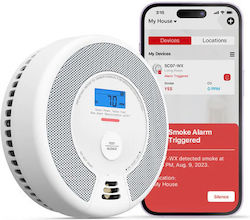
1. The standalone smoke detector (smoke alarm) is a simple device that operates on batteries and, when it detects smoke, sounds a loud, built-in siren. It is the minimum protection for every home and what the law requires for Airbnbs. Its installation is very easy and can be done by the owner themselves at zero cost apart from the device, as no specialist technician is needed for installation.


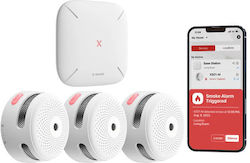


2. The fire detection system (fire detection system), on the other hand, is a complete system consisting of a central fire detection panel, multiple detectors (smoke, heat, etc.) connected by cable or wirelessly, sirens and manual call points for manual activation. This is usually required by the Fire Protection Regulation for properties near forests, especially in higher risk categories, and covers the entire house. With the fire detection system, you always know exactly where the alarm was triggered (in which zone), and it can be connected to a monitoring center or the Fire Department for more immediate notification in case of an incident.
-
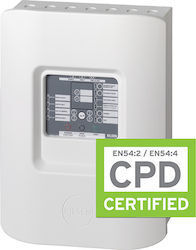 Fire detection panels
-
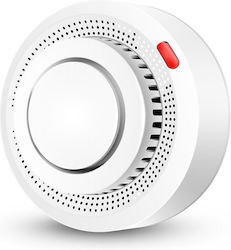 Detectors
-
 Sirens
-
 Button
✔️ Where should the detectors be placed?
The general rule "the more, the better" applies here, however there are some strategic points that can help in case of emergency:
- In every bedroom: These are among the most important areas of the house, where installation is essential. During sleep, we are more vulnerable, as we cannot see or smell smoke. The detector acts as a "guardian," using a loud sound to activate the only sense that protects us while sleeping: hearing.
- Outside the bedrooms: Another equally important spot is the hallway or corridor leading to the bedrooms. This point is strategic for two reasons. First, it acts as an early warning system, activating before smoke reaches the bedroom door. Second, it serves as a "monitor" of the escape route, immediately alerting if the hallway starts to fill with smoke.
- On every floor: It is best to have at least one smoke detector per floor, including the basement. Smoke rises, so a fire that starts in the living room (ground floor) may not trigger a detector in the first-floor hallway until the staircase is already filled with dangerous smoke, blocking escape. Each floor needs its own source of protection.
- Kitchen: A regular smoke detector should never be installed here, as steam and cooking will cause constant false alarms, with the risk that this sound becomes routine and is ignored. For the kitchen, the solution is a heat detector, which completely ignores smoke and steam, as it is only activated by a sudden rise in temperature, such as an oil fire, or if the temperature exceeds a dangerous limit (e.g. 58°C).
- Boiler room, Basement or Storage: The basement or storage room are high-risk areas that are often forgotten. They may house the boiler, washing machine, electrical panels, or stored flammable materials, from which a fire can start and develop for hours without being noticed, as these are areas of the house we do not visit very often.
✔️ Proper maintenance
A system that is not maintained properly or at all is as good as not having one. Therefore, it is good to follow some preventive steps at regular intervals to ensure that the system works effectively.
- Once a month you can press the "Test" button on the detector.
- Once a year you need to change the batteries in ALL standalone detectors. A good practice is to do this when you change the clocks, so you never forget.
- Every 8-10 years you should replace the sensors in the smoke detectors, as they wear out and stop being effective. You can check their manufacturing date on the back of the device.
Remember
The installation of fire detection systems is no longer an optional upgrade. For thousands of property owners, it is a legal obligation with strict deadlines, while for everyone else it is the primary line of defense for property and, most importantly, for our fellow people.
Whether the law requires it or not, investing in a few simple smoke detectors is the least you can do.




Be the first to leave a comment!