

Ironing Systems Buying Guide
Ironing may be one of the most boring household chores, but somehow it has to be done, what can we do!
And since it has to be done, you should make sure you have the best and most suitable appliance to help you. And that is none other than an ironing system!
But what is an ironing system? In traditional steam irons, all functions and steam production take place in the body of the appliance. In an ironing system, on the other hand, the steam is produced in the boiler and is delivered to the iron through the hose cable. It is considerably more powerful than a steam iron, as it produces more steam and greater pressure.
So how will you choose the best ironing system? Let's take a look at the most important features one by one!
1. Power
In an ironing system, power is measured in Watt and indicates how quickly the iron will reach the desired temperature so it is ready for use. In other words, the higher the power, the faster the appliance heats up. It is an important feature, but not the only criterion when purchasing. Combined with the other features we will see below, you can more easily arrive at the ideal choice.
- As an indication, ironing systems with power up to 2200 Watt are ideal for you if you want something more than a simple iron, but you do not iron very often or large amounts of clothes, e.g. for a couple or a small family.
- Ironing systems with power 2300-2500 Watt are suitable for larger families with medium daily clothing needs or for fewer people with a need for more frequent and demanding ironing, e.g. shirts.
- Finally, ironing systems with power from 2600 Watt and above are mainly intended for use in households with many people, who have daily ironing needs and a large volume of clothes, e.g. families with small children who often get their clothes dirty.

2. Steam Pressure
Steam pressure is measured in bar and is one of the main characteristics you should consider when looking for the right ironing system for you. Essentially, it expresses the pressure at which steam is generated in the boiler and consequently the force with which it exits from the plate. Higher steam pressure usually means greater performance.
3. Steam Performance
The steam performance in an ironing system is measured in grams per minute (gr/min) and is divided into two functions. First, the steam that is continuously produced while the iron is in operation and second, the steam burst, which is the extra powerful steam produced when we press the corresponding button on the iron's handle. In many ironing systems, there is the option to adjust the produced steam according to the specific fabric. Obviously, the stronger the steam production, the easier it is to iron fabrics better and faster, as the steam penetrates deeper into the fibers of the clothes.
Based on the two factors mentioned above, which are related to the produced steam, you can arrive at the best choice for you, depending on your usage.
For demanding use | High pressure & performance
Does the pile of un-ironed clothes never get any smaller in your home? Do you need a freshly ironed shirt every day, or do you have small children who constantly stain their clothes? Then you need an ironing system with high pressure, as well as high steam output, which guarantee the best ironing results, even on the most demanding fabrics.
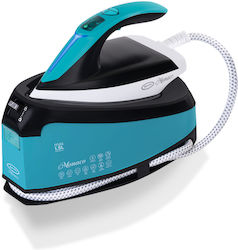
Top choices in ironing systems for demanding use




For frequent use | Medium pressure & performance
If your ironing needs are 1-2 times a week for a medium amount of clothes (about 20-30), then choose an ironing system with steam pressure 6-6.9 bar and steam output 120-165 gr/min. An ideal choice for small families, couples, or those living alone, but who need some uniforms for their work.
Top choices in ironing systems for frequent use


For light use | Low pressure & performance
Or maybe you are one of those who hate ironing, there are not many people in your home and your ironing needs are very few, or maybe you have a dryer and it does half the work for you? Whatever applies from the above, an ironing system with steam pressure 5-5.9 bar and steam output 90-115 gr/min is enough to cover your needs.
Top choices in ironing systems for light use


4. Soleplate & coating
There are many different types of soleplates based on their material and design. Each manufacturer uses its own, however most soleplates feature an anti-stick or ceramic coating for better glide on fabrics. There are soleplates made of aluminum, some that are stainless or scratch-resistant, and even soleplates with a palladium coating.
But apart from the material, the distribution of the holes on a soleplate is also important, through which the steam comes out. Better distribution means better steam penetration into the fabric. In addition, the tip and grooves of the soleplate should be narrow so that difficult areas, such as spots near buttons and creases, can be ironed easily.
5. Water tank & capacity
The steam in an ironing system comes from the water that is in the boiler (tank). There are two types of tanks, those that have a valve and those that have a refill function. In the first type, unscrewing the valve is required in order to refill the tank, while in the second type refilling can be done at any time, for comfort and speed, whether it is a ironing system with a removable water tank or not.
SkroutzTip: A larger tank capacity means less time between refills, while guaranteeing faster ironing.
6. Cleaning
When it comes to cleaning, it is something that is worth considering both when purchasing and when using the system you choose. It is very important to use deionized water every time, so as to ensure a longer lifespan for your device, but you should not neglect the descaling system that the system you are considering may or may not have. Let’s see what forms you may encounter:
- Self-cleaning ironing systems: These systems reduce limescale buildup and maintain their performance at a high level, without the need for regular manual maintenance. More specifically, the device itself removes limescale through a strong flow of water or steam, a function usually found in more premium models.
- Ironing systems with notification function: Most systems now have a cleaning notification function, which informs you when descaling or removal of other residues is required, usually through a light indicator or an audible signal.
- Ironing systems with cleaning container: These systems are equipped with functions that collect and remove limescale into a special container, which is included, notifying you when it needs to be cleaned.
- Ironing systems with anti-calc filter: Finally, ironing systems with an anti-calc filter prevent limescale buildup through the filter, which is good to replace every 6-12 months, depending on usage and the hardness of the water used, in case it is not deionized.
7. Extra features & functions
Vertical steam
The vertical steam function in a ironing system is very important and useful if you want to iron clothes on a hanger easily and quickly, such as a dress or other hanging fabrics, like curtains. This function essentially provides equally good steam performance both vertically and horizontally, so you can achieve the desired results every time.
Automatic temperature control
Systems that feature automatic temperature control make your life easier and ironing a breeze, since no manual temperature adjustment is required. Instead, the iron detects the type of fabric on its own and adjusts the temperature accordingly.
Anti-drip system
A very important role in an ironing system apart from its ironing performance is also keeping clothes clean. The switch from a high to a lower temperature usually results in the release of water droplets, which “stain” the fabrics. Ironing systems with an anti-drip function are ideal for use on fabrics that require low temperatures.
Transport lock
Finally, the transport lock is an extra feature that helps ensure safety during transport of the appliance, while also protecting against accidental release of the iron by children or pets.
Don't forget! By taking into account the above individual characteristics and combining those that suit your needs, you can arrive at the ideal choice for you. Before deciding, you can also take a look at the reviews of other users, to see their opinions and experiences, which can help you reach a final decision much more easily.
You can also watch the video with top recommendations for Ironing Systems:
Finally, you can also take a look at the guide with the best choices in ironing systems for every need.
Relevant Articles
What is the best steam generator iron for 2026?
The Best Steam Irons on the Market
Which steam iron should you buy to make ironing a breeze?
Be the first to leave a comment!